How to Identify Vinyl Record Pressings: A Guide
Knowing how to identify a vinyl record pressing is the single most valuable skill a collector can learn. Two copies of the same album can look nearly identical from the outside yet differ in price by hundreds of dollars, and the differences almost always live in details you have to know how to look for. This guide walks through the four signals that matter most: catalog number, dead wax markings, label design, and Discogs verification.
Step 1: Start with the Catalog Number
The catalog number is the cheapest, fastest clue you have. Find it on the spine, the back cover, and the record label itself. Original pressings share the catalog number that was issued when the album first came out. Later reissues almost always change at least one piece of that string.
Common reissue tells include:
- A different prefix (for example a US release reissued under a UK catalog number).
- Added letters or suffixes like "RE," "RM," or "REISSUE."
- A barcode stamped onto a record from before the early 1980s, when barcodes became standard on retail records.
- A modern copyright date printed on the sleeve that does not match the original release year.
Catalog number alone is not proof. A reissue can sometimes reuse the original number, especially in limited audiophile runs. Use it as your starting hypothesis, then confirm with the next two checks.
Step 2: Read the Dead Wax (Runout Groove)
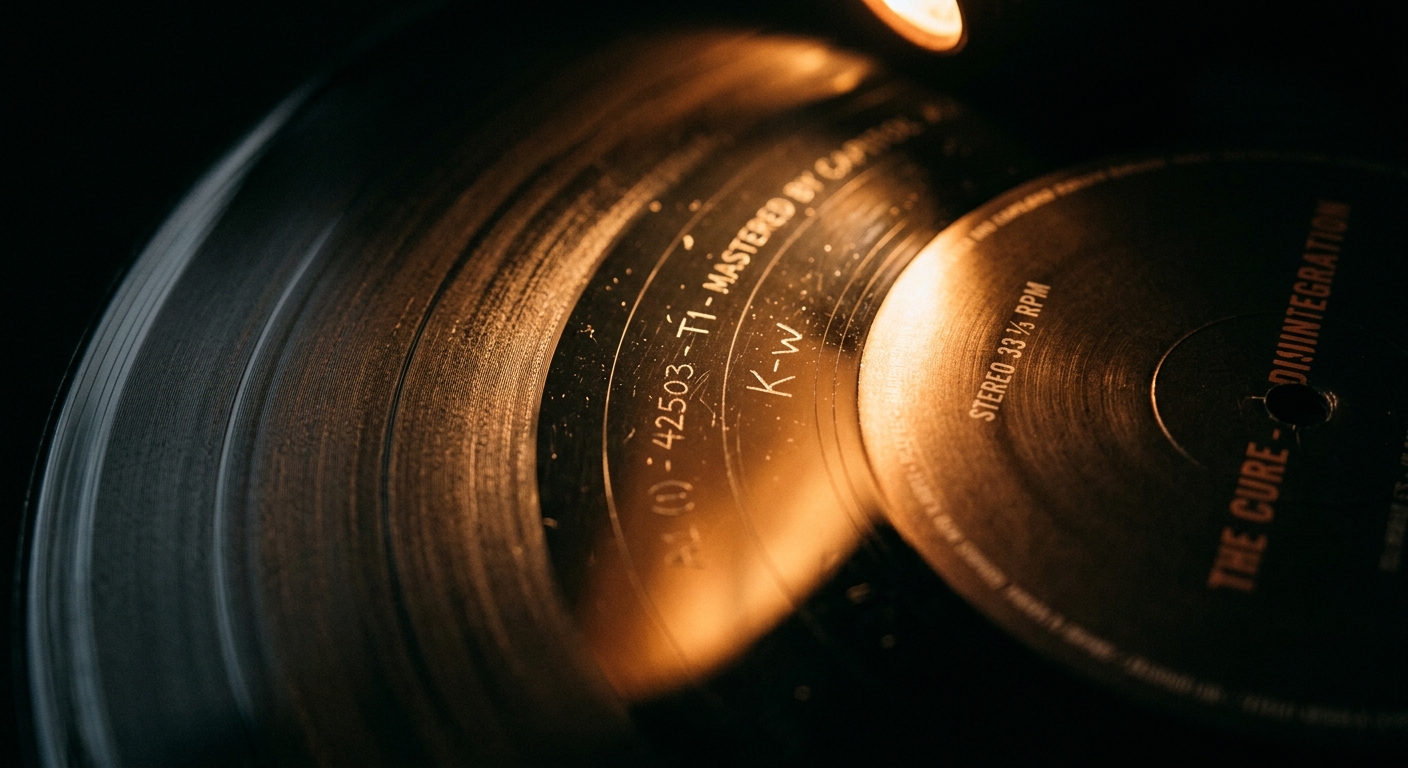
The dead wax is the smooth circular band between the final music groove and the center label. Every side of a vinyl record has one. Inside that band is the most honest information about the pressing: matrix numbers, mastering engineer initials, pressing plant codes, hand-etched symbols, and quality-control stamps. Collectors call this whole package the runout matrix, and they call the matrix number itself the record's "fingerprint."
To read it, hold the record at roughly a 45-degree angle beneath a bright LED flashlight. Rotate it slowly. The shallow shadows make faint etchings far easier to see than looking at the record flat under overhead lighting. A magnifying glass or loupe helps with very small text.
Many first pressings show a side-A and side-B matrix that ends with "-A1" or "-B1" or simply "A1 / B1." Examples collectors reference often include "A//1 B//1" (UK Led Zeppelin), "ST-A-712285-A" (Atlantic stereo with a catalog year encoded in the middle), and the classic "PL-902-A MASTERDISK EDP" (Misfits Plan 9, where the trailing "MASTERDISK" identifies the mastering house).
You do not need to memorize these. Decode the segments and then search what you find. The first segment is often a format prefix (ST for stereo, nothing for mono). Then a label or series identifier. Sometimes a year code. Then the master or recording number. Finally a revision suffix that ends in A, B, C, and so on. A 1 suffix usually means first lacquer cut, which usually means first pressing for that plant.
Step 3: Compare the Label Design
Record labels change their logo style, color scheme, and copyright text on a known schedule. The transition between label designs is one of the easiest visual tells, and it often pins a pressing to a tighter window than the catalog number alone.
A few examples worth knowing:
- Parlophone UK Beatles originals used a black and yellow label with "The Gramophone Co." in the radial text and the red and white "psychedelic" inner sleeve for Sgt. Pepper. Later pressings dropped the Gramophone Co. text and used EMI box label designs.
- Island Records UK Tea for the Tillerman was issued on an entirely pink rim label during the label's earliest months. The pink rim was replaced quickly, so surviving pink rim copies are almost always first pressings.
- Atlantic Records switched from the green and blue split label to the red and black "bullseye" in 1968. Anything claiming to be an Atlantic first press from 1970 onward should have the bullseye.
Label design is high signal for major labels with strong design history, and lower signal for smaller or more erratic labels. Pair it with the other checks.
Step 4: Verify on Discogs
Discogs is the most comprehensive public database of vinyl releases in the world. For any record you handle more than once, it is worth the 30 seconds to verify.
The workflow that catches the most errors:
- Search by artist and album.
- Open the release page that matches your catalog number.
- Compare the matrix/runout strings the community has documented against what you see in the dead wax.
- Confirm the year, label, and pressing plant match your record.
If you cannot find a matching release, that itself is information. Either you have a rare or undocumented pressing, or the record is a counterfeit. Both outcomes deserve a second look before you spend serious money.
Reissue Clues to Watch For
Some records loudly announce that they are reissues. None of these clues means a record is bad, since many modern reissues sound excellent, but they do mean the record is not an original pressing.
- "180 gram" printed anywhere on the cover or hype sticker.
- "Remastered" or "Audiophile" labels.
- Barcode on an album originally issued before the early 1980s.
- Modern copyright date that does not match the release year on the spine.
- Shrink-wrap hype stickers that were not standard in the original release year.
Common Mistakes to Avoid
- Assuming the oldest-looking copy is automatically original. Sleeves yellow unevenly, and reissues can sit in warehouses for years.
- Trusting only the cover artwork. Artwork can be reused, recolored, or photocopied across many pressings.
- Ignoring the dead wax because it is hard to read. A flashlight and ten extra seconds will save you from misidentifying a record worth a fraction of its perceived value.
- Skipping Discogs. Even experienced collectors double-check using the database.
Putting It Together
The reliable identification workflow is the same one record shops use every day. Check the catalog number. Read the dead wax with a flashlight. Compare the label design to known transitions. Verify on Discogs. When all four line up, you can price and grade the record with confidence. When they disagree, treat the disagreement as a signal to slow down before you buy or sell.
Original pressings are not always better sounding than modern reissues. Mastering quality, pressing plant, and the condition of your specific copy matter more than the year on the sleeve. What original pressings do give you is authenticity, historical accuracy, and the strongest position when you are documenting a collection.
Frequently Asked Questions
Are original pressings always worth more?
Often, but not always. Rarity, condition, and demand drive market value more than age. A clean 1985 reissue of a popular album can easily outsell a beat-up 1972 first pressing.
Can a record without a barcode be original?
Yes. Barcodes became standard on vinyl in the early 1980s. Many original pressings of pre-1980 albums correctly have no barcode at all.
Is Discogs reliable for identifying pressings?
Yes. Discogs is widely considered the most accurate public database for vinyl releases, and it is the standard reference record shops, collectors, and archivists use worldwide.
Do matrix numbers always start with A1 and B1?
No. The convention is common but not universal. Some labels use -A1 / -B1, others use plain A / B with a suffix, and some use entirely proprietary systems. The point is that the A-side and B-side strings should each be unique to a specific mastering, and you can search those strings on Discogs to confirm.
Keep your collection organized so the pressing details stay attached to the right record. A collection tracker that captures catalog number, runout notes, and pressing year in one place makes this kind of identification much faster the next time you handle the same record.
A spreadsheet tracks what you own. What's Spinning identifies what's playing.
On-device vinyl ID logs your listening history automatically. 7-day free trial.
Looking for Shazam for vinyl?
What's Spinning identifies what's playing on your turntable on-device, logs history, and AirPlays now-playing to your TV.
Comparing vinyl ID apps?
Analog requires Discogs and is iPhone-first (iPad coming). What's Spinning works without Discogs on iPhone and iPad with AirPlay.
Try What's Spinning Free
Turn your iPad into a live now-playing display. Track every record you spin.
START FREE TRIALThen $4.99/mo or $39.99/yr · Cancel anytime