Using Vinyl Records for a Relaxing Evening: A Practical Listening Ritual
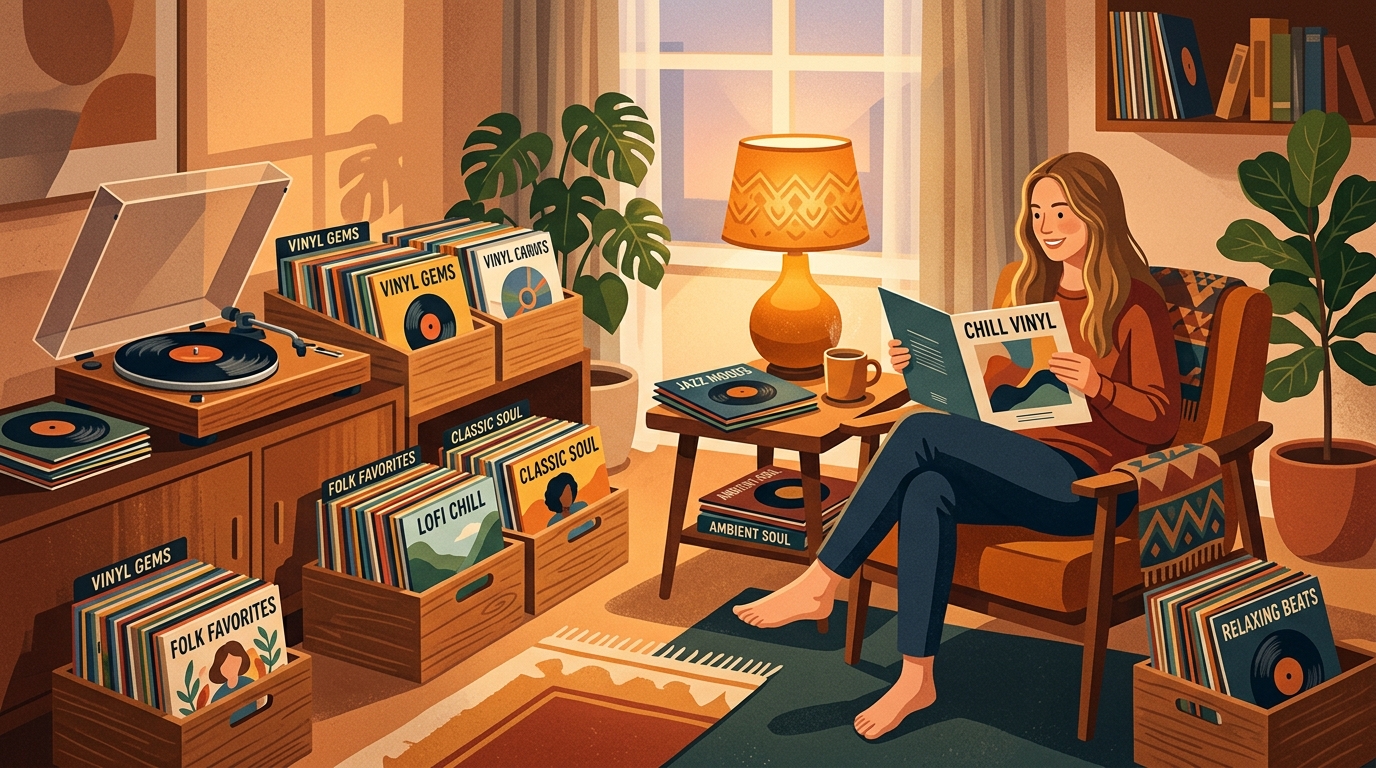
If your evening routine has become a blur of tabs, notifications, and half-watched shows, vinyl can be a surprisingly effective reset. A record asks for one small decision, then gives you 18 to 25 minutes of uninterrupted attention. That is the heart of this use case vinyl for relaxation: not nostalgia for its own sake, but a repeatable ritual that turns music into a boundary between the busy part of the day and the quieter part.
The format is healthy, too. According to the RIAA 2023 year-end report, U.S. vinyl revenue grew 10% to $1.4 billion, its seventeenth consecutive year of growth. LP and EP shipments reached 43.2 million units, and vinyl accounted for 71% of physical format revenue. People are not just streaming music in the background. They are still buying objects that encourage slower listening.
Why vinyl works so well for decompression
Relaxation is not only about choosing gentle music. It is about reducing decision fatigue. Streaming gives you almost infinite choice, which is wonderful until you spend 12 minutes skipping tracks. A record solves that by turning the evening into a sequence: choose the album, clean the side, lower the stylus, sit down, and let the room settle. The sleeve, liner notes, and side break give your hands something calm to do before your brain catches up.
There is real science behind the broader idea that music can reduce stress. A 2020 systematic review and two meta-analyses in Health Psychology Review looked at 104 randomized controlled trials, 327 effect sizes, and 9,617 participants. The authors found significant effects of music interventions on both physiological stress outcomes, with an effect size of d = .380, and psychological stress outcomes, with d = .545. They also found larger effects for heart rate than for blood pressure or hormone levels. In plain English: music is not magic, but it is a measurable stress tool.
Build a listening stack for the mood you actually want
For a calming evening, pick records that suit the shape of the night. A jazz record like Bill Evans' Waltz for Debby works when you want conversation and warmth. Ambient records, such as Brian Eno's Ambient 1: Music for Airports, are useful when you want fewer lyrics competing with your thoughts. Soul, folk, bossa nova, and mellow 1970s singer-songwriter albums all make sense because they reward side-length listening without demanding constant attention.
Keep a small relaxation crate instead of searching the entire shelf every night. Eight to twelve records is plenty: one quiet jazz pick, one instrumental record, one acoustic record, one familiar comfort album, one rainy-night soul record, one low-volume classical or ambient record, and a few seasonal favorites. Use What's Spinning once here as a practical helper: track which records you actually play on calm nights, then let that history refine the crate over time.
Use the side break as a feature, not an interruption
The side break is one of vinyl's underrated strengths. A 40-minute album naturally becomes two smaller chapters, which makes it easier to pause, stretch, refill tea, dim a light, or decide whether you are done for the night. That matters because relaxation routines work best when they are easy to repeat. You are not committing to an endless queue. You are committing to one side.
A study published in PLOS ONE tested music and stress response in 60 healthy women using a standardized psychosocial stress test. The results were mixed, and the study did not say that any piece of music automatically lowers every stress marker. That nuance is useful for record collectors. The goal is not to find one scientifically perfect album. The goal is to choose music that reliably slows your behavior and helps you move out of work mode.
Make the room part of the record
Vinyl relaxation works best when the setup feels inviting before the music starts. Put the turntable where it is easy to use, not where it looks most impressive. Keep a carbon fiber brush nearby, store the relaxation crate within reach, and make the lighting warm enough that you are not tempted to grab your phone. Lower volume usually beats hi-fi fireworks at night. You want enough detail to hear the room in the recording, not enough volume to turn listening into an event.
Sleep guidance points in the same direction. The Sleep Foundation notes that music before bed may decrease the time it takes to fall asleep and improve sleep quality, and suggests relaxing music around 60 to 80 beats per minute. Vinyl is not ideal if you plan to fall asleep with music running, since the side will end and the stylus needs care. But for the hour before bed, a short record ritual can be a better fit than an autoplaying algorithm.
A simple 45-minute vinyl wind-down
Start by choosing the record before you sit down, preferably from a limited crate. Brush the record, put your phone across the room, and play side A at a modest volume. During the side break, do one useful reset: make tomorrow's quick note, clear a glass from the table, or start the kettle. Then play side B only if you still want music. The point is permission to stop. A relaxing vinyl night should feel finished, not abandoned.
That is the larger appeal. Vinyl makes music physical enough to become a habit, limited enough to reduce choice, and rich enough to make an ordinary evening feel intentional. For collectors, it also gives the shelf a job beyond ownership. The right record at the right hour can turn a room into a softer place to land.
FAQ
What kind of vinyl is best for relaxation?
Choose records with a steady mood and fewer jarring transitions. Jazz ballads, ambient, folk, bossa nova, mellow soul, solo piano, and acoustic singer-songwriter albums are good starting points.
Is vinyl better than streaming for relaxing?
Not automatically. Streaming is easier, but vinyl reduces skipping and endless browsing. If the ritual helps you slow down and listen to one album, vinyl may be better for your evening routine.
Should I play records before bed?
Yes, if you are awake enough to lift the tonearm or your turntable has auto-stop. For falling asleep, streaming, radio, or a sleep timer is safer for your stylus and records.
How many records should be in a relaxation crate?
Start with eight to twelve records. That is enough variety for different moods, but small enough to prevent the whole routine from turning into another decision-heavy task.
A spreadsheet tracks what you own. What's Spinning identifies what's playing.
On-device vinyl ID logs your listening history automatically. 7-day free trial.
Looking for Shazam for vinyl?
What's Spinning identifies what's playing on your turntable on-device, logs history, and AirPlays now-playing to your TV.
Comparing vinyl ID apps?
Analog requires Discogs and is iPhone-first (iPad coming). What's Spinning works without Discogs on iPhone and iPad with AirPlay.
Try What's Spinning Free
Turn your iPad into a live now-playing display. Track every record you spin.
START FREE TRIALThen $4.99/mo or $39.99/yr · Cancel anytime